
My Digital Swim Coach
I Chat With Chat (so you don’t have to) - episode 54

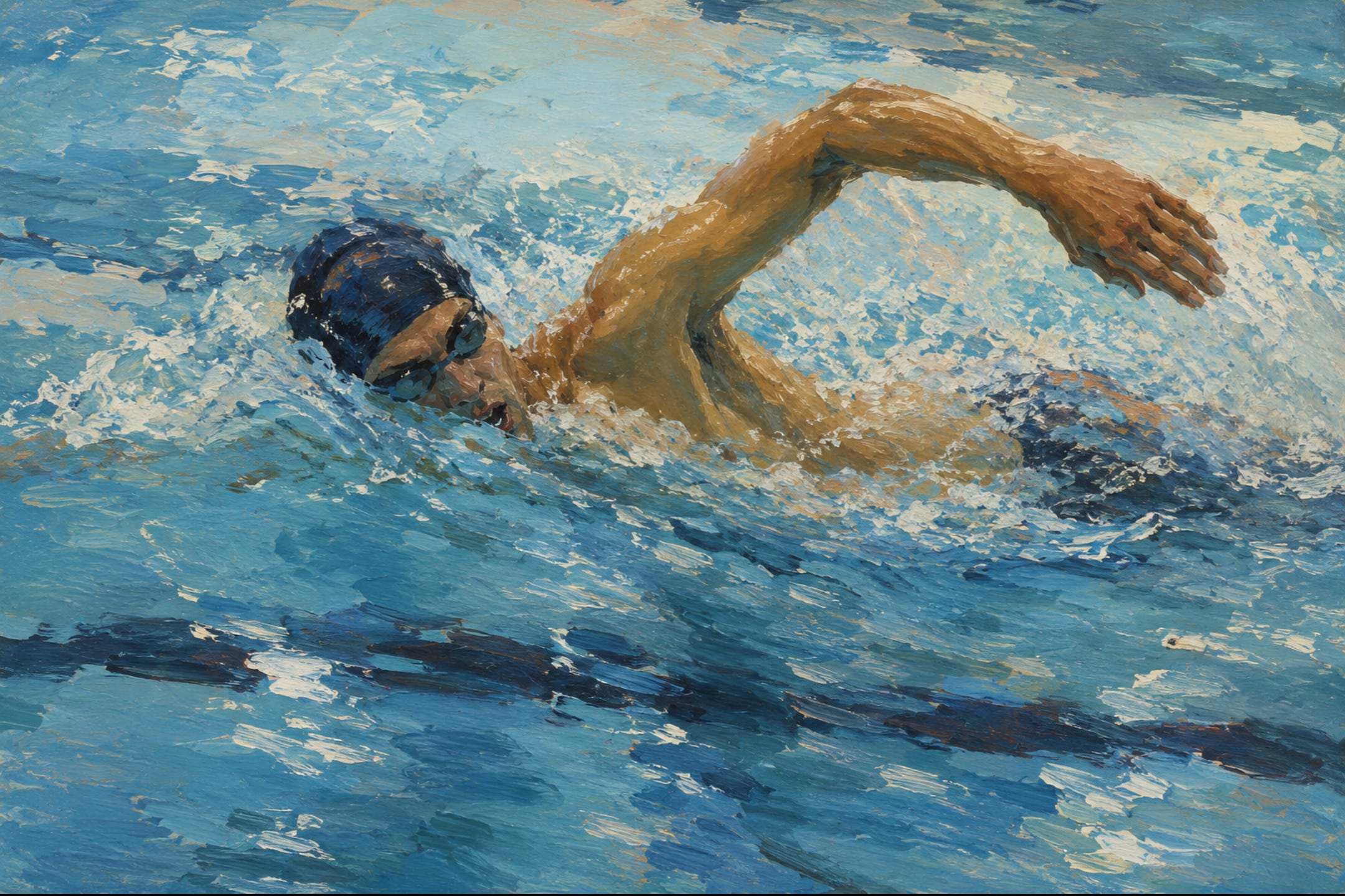
I was once the 12-and-under free-style gold medalist of Camp Moosilauke. Do not think I am very much impressed by that as a swimming title, but it meant a lot to me at the time.
It wasn’t like kids’ swimming today, with coaches and endless pre-dawn training and huge parent-choked swim meets you could hear a mile away. If I had any instruction at all, I don’t remember it. I just dove in and flailed away as hard and fast as I could, admittedly against fairly random opposition from the pre-teens at Camp Winnipesaukee.
My competitive swimming career pretty much ended there, in the waters of Upper Baker Pond in New Hampshire. (Hey, it was a BIG pond!).
In the half century that followed, I mostly just splashed idly around in pools to cool off on hot summer days.
But a few years ago I decided to take my orthopedist’s advice and find a form of aerobic exercise that wouldn’t pound my knees to mush. So I trotted out the old medal-winning freestyle and began to swim laps.
I was shocked.
It was both exhausting and painful — after more than a few lengths of standard crawl my shoulders and elbows felt damaged, and I had to stop to catch my breath.
I eventually discovered that if I swam breast stroke every other length I could sustain it for longer distances. With enormous effort I worked up to swimming alternate strokes for half a mile, an agonizing 900 yards.
I dreaded the swim, but already appreciated the benefits enough that I continued swimming in the winter at the a rec center pool.
That’s when I noticed that, as I swam my dutiful, brute-force 36 lengths, overweight middle-aged women in the next lane serenely cruised past me as if I were treading water. I knew I shouldn’t care. This wasn’t a race, after all, and I wasn’t exactly in the first flush of youth myself.
But I guess the memory of gold medals still lived inside of me, so I decided to ask Chat what was up.
CHAT: Swimming is unusually technique-dependent. A good swimmer reduces drag, keeps the body aligned, rotates efficiently, gets useful propulsion from each stroke, and wastes very little energy moving water in directions that don’t move the body forward.
So someone who looks much less “fit” than you can streak past you while using less energy. Your tennis conditioning and upper-body strength don’t buy you nearly as much in the pool as you might expect. In fact, trying to muscle your way through the water can make you slower.
Thus began a year-long, incremental tutorial in swimming technique I had no idea existed. I became obsessed with improving my stroke. A tennis partner asked me why, if I was swimming to improve my aerobic fitness and burn calories, efficient form was even desirable. I had no good answer.
I knew it wasn’t just to avoid being passed by those lovely women. But it would be a long time before I understood the reason myself.
The way it worked was, Chat would give me some inscrutable principle that I’d attempt to decipher in my next swim. And fail. Then I would relay my observations, and data from my Apple Watch (heart rate, strokes and time per lap) and Chat would refine its instruction. This way, tacking right and left, we’d eventually make progress, and one day in the pool, I’d suddenly feel what it meant to “set my arm to catch the water.”
That was the first breakthrough, and the most important. For my entire life I had thought the whole point of the crawl was to force my way through the water by churning arms and shoulders. Chat’s first instruction — that the power didn’t come from your arms but from rotating your core — seemed a ridiculous idea. How could twisting your core move you forward?
It took more swims than I’d like to admit, but suddenly I got it. My arms weren’t an engine, they were the paddles on a paddle wheel. The core rotation turned the wheel and the paddles followed, pushing the water with them.
The result was both less exhausting, and less punishing. Soon, I was able to swim the entire 900 yards without falling back on alternating breast stroke laps.
Less exhausting, but still exhausting to the point where I never was positive I wouldn’t quit before the 36th length. I’d reduced my overall time by a few minutes, but I was often still one of the slower—and I assumed more exhausted—swimmers in the pool.
Now that the main problem was understood, with Chat’s help, I began seeing the chain of smaller form fails that had been hidden under the hood:
My breathing was erratic and inefficient.
My left side wasn’t rotating as much as my right.
I was gliding too long and stalling, or not long enough and rushing the stroke.
After I reported each swim’s results, Chat would offer another instruction. “Blow tiny bubbles.” “Catch the water.” “Climb over a barrel.” Each sounded like swimming fortune cookies. None of it made sense.
Until, suddenly, it did.
As with the paddle wheel revelation, I’d spend several swims faithfully trying to decode the advice and get nowhere. Then one morning my body would quietly understand what my mind hadn’t.
At this point I was clearly making progress. My early laps were dramatically faster and used fewer strokes. But then both time and strokes would increase, not because I was tired, but because my form began to slide for reasons I didn’t understand.
Weeks went by with swim theory buzzing in my head. The time and stroke counts remained little improved, and I had to remind myself I could now confidently swim 900 yards crawl without stopping for breath when just months earlier I struggled to swim 50 yards.
Then summer came and I switched back to the outdoor pool. No more sharing lanes or worrying if I was keeping up with the neighbors. And then I realized instead of spending mental energy counting laps - “is that 26? Or 28?” - I could listen to music on my waterproof headphones. Roughly eight songs equaled half a mile, although more often than not it would end up being a thousand yards instead of 900, and to my surprise, that was no hardship.
The bubbles, the breathing, the glide — it all was becoming automatic rather than something I had to think much about.
About then I realized there was one thing I’d never asked: How should the forward hand enter the water?
“Minimum splash?” I asked.
CHAT: It might have that effect, but you shouldn’t be thinking “no splash.” Picture inserting your hand into a letter slot in a door.”
This time I got it immediately. That image—precisely placing my hand into a narrow opening — unlocked something in my head. In a flash, I could see that all the things Chat had been telling me weren’t disparate parts, but one smooth chain, each segment the natural consequence of what preceded it. The fortune cookies hadn’t been wrong. They’d just been describing an elephant one body part at a time.
I no longer needed to think: set the forehand, elbows high, blow bubbles, breathe!
Rotating my hips and shoulders pulled everything into place in sequence.
It just . . . happened.
This felt good. It felt obvious.
When the eighth song finished and I checked the Apple Watch, I’d swum further, faster and in fewer strokes than ever before.
Suddenly I knew why I’d put so much effort into improving a technique that would never be tested in a race. And it wasn’t (entirely) about the women passing me by. They may still pass me. I no longer care.
As I swim now, I listen to the music, think about what I’ve been reading, plan what I want to write.
Or I simply enjoy the feeling of my body moving through the water, finally not thinking of anything at all.
*Extra credit if you noticed something unusual about the first two sentences.
I noticed nothing unusual about the first two sentences.