

Will AI Eat Your Brain?
I Chat With Chat (so you don’t have to) - episode 39

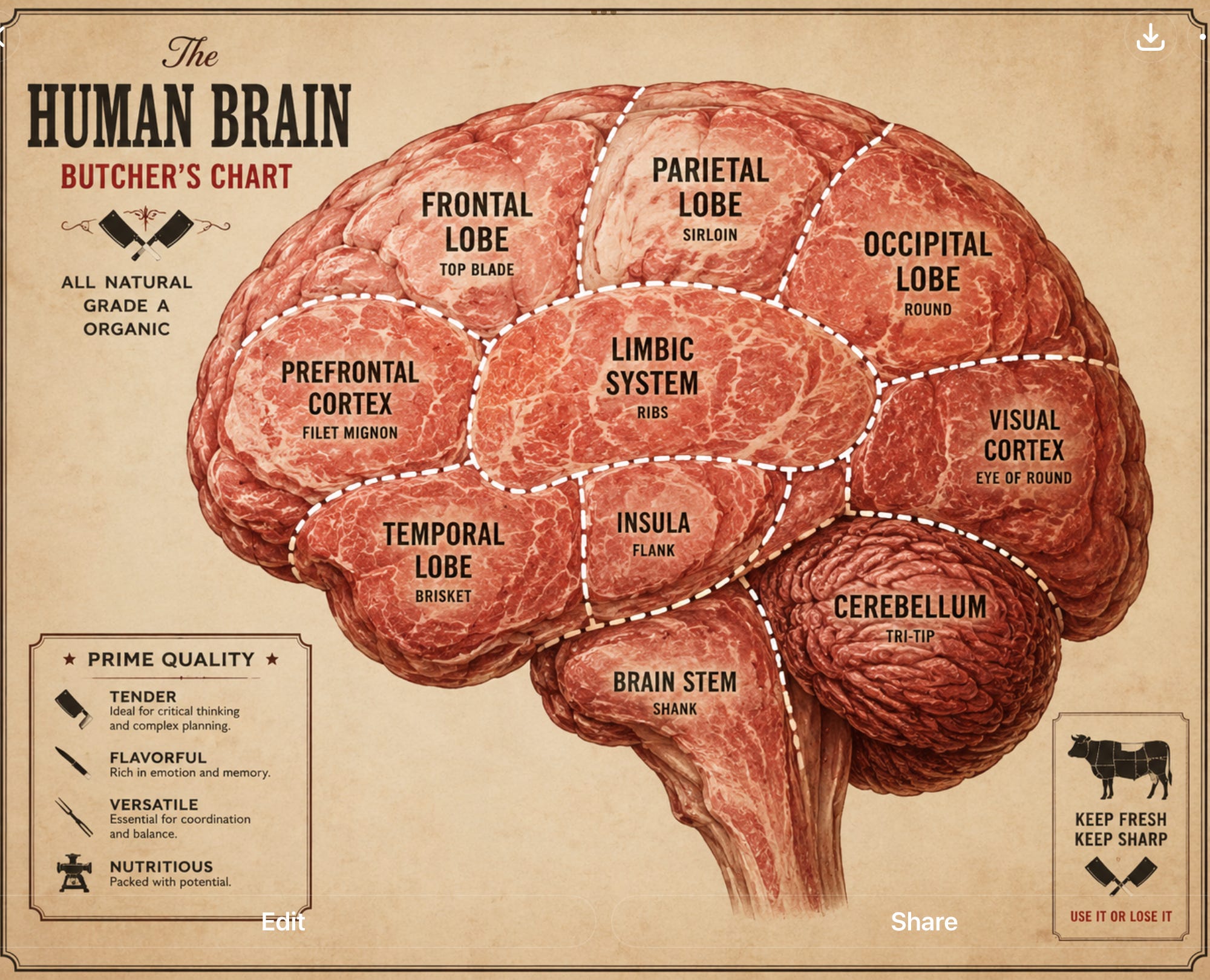
There’s a rising tide of concern that using AI may destroy your ability to think.
Two recent articles generating attention seem to be converging on that dire prognosis. In the New York Times, Rebecca Winthrop, who led the Brookings Institution’s global task force on A.I. and education, writes that she has “drawn a sharp line in the sand: no A.I. for writing.” She continued:
I’m not talking about expense reports or routine emails. I mean actual writing, and the creative brainstorming that precedes it to explore different perspectives or develop novel insights. Increasingly, many people I talk to — from students to teachers to peers — tell me that they think it’s OK to use A.I. chatbots for brainstorming as long as they do the “real work” of writing.
But this misunderstands something critical: Brainstorming is the work that’s fundamental to writing. [The impact of using AI is to constrict our full range of thoughts and our ability to generate original and useful ideas — what we call creative thinking.
And in the Atlantic, Eve Fairbanks writes:
No matter how much we may tell ourselves that AI is just a tool like spell-check, it isn’t. When we use AI to flesh out our ideas we lose the most important part of the writing process: thinking.
My reaction? I find it hard to believe either of these women has spent much time using AI as a serious intellectual collaborator.
As an experiment, I told Chat to imagine that I was writing an essay. I submitted Winthrop’s lead paragraphs above and asked for notes. Here’s the response:
CHAT: The prose is polished and the concern is legitimate, but the argument overstates its case. The claim that AI “constricts our full range of thoughts” is so sweeping that it immediately collides with the lived experience of many sophisticated users. Writers have always developed ideas through interaction — with editors, books, colleagues, arguments, and conversation — and for many people AI functions less as a replacement for thinking than as a demanding intellectual partner that provokes, challenges, and refines thought. Advanced users are often not asking for prefab ideas but engaging in an iterative process: challenge this assumption, make the opposite case, expose weaknesses, sharpen this distinction. That experience feels less like cognitive surrender than accelerated dialectic. The piece collapses an important distinction between outsourcing cognition and extending cognition through active engagement. A passive user may indeed become intellectually lazy, but many serious users experience the opposite effect: more iteration, more counterarguments, more conceptual exploration, and more pressure to discriminate between weak and strong ideas. I think the argument would become much stronger if it focused less on the blanket claim that AI constricts thought and more on the real danger — that fluent AI output can create the illusion of understanding and allow people, especially students, to bypass the productive struggle that genuine learning and originality require.
I happen to agree with that analysis. But no doubt either of these writers might have some problems with it. If instead of simply harrumphing and shutting the laptop they thought carefully about their objections and entered them back into the prompt, that would kick off exactly the “accelerated dialectic” Chat describes.
By now, I’ve had countless experiences using AI where I’ve begun with a half-formed, or even fully formed, idea, and ended up refining it, filling in holes, bending it around obstacles I hadn’t even known were there to wind up with a deeper understanding and a far stronger version of my original thought. I treat Chat not as an idea generator, but as a level-headed, super-articulate and encyclopedically informed colleague who can challenge me, and works most productively when I challenge it back.
The result has not been diminishment of thought, but a stimulation and expansion of it.
So what’s up with this wave of alarm, of which these essays are only a tiny sample?
I think the fluency and sophistication of machine intelligence - an advance that seemed to appear out of nowhere - has given us all a shock.
At first, the play was to seize on its flaws - the hallucinations, the flubs in simple arithmetic, the stilted verbiage. But as those claims pale beside the increasingly eloquent and astonishingly polymathic output, the argument is shifting from “they don’t work” to “anything touched by them is intellectually contaminated.”
It is an allergic reaction, a form of panic that will fade with familiarity.
Believe me, I know that there are no shortage of real threats as this civilization altering technology takes hold.
But as far as brain-eating is concerned, Chat is strictly vegetarian.
And I mostly agree with you, Tom. I use Claude to copy edit drafts. I have to keep reminding him to stay in his lane as a copy editor and not blow smoke up my butt by over-praising what I’ve written. Recently, I asked him to review a novel I’d just finished with the eyes of a hard-ass acquisitions editor who knows the marketplace but to stop short of making any suggestions about style/tone changes to the narrative. He offered a thorough analysis with some cogent insights that affirmed what I already knew. But I absolutely don’t want to cross the line of turning Claude into my script doctor.
It seems like those writers have a different process and don't want to change it. So, fine. We all do it our own way.